

In the April Issue:
Heightened Activity at Arenal Attracts Visitors
Tips for Language Learners: The Nature of Language
Heightened Activity at the Arenal Volcano
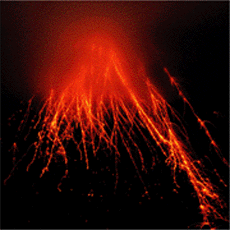 Tourists and residents of La Fortuna recently experienced a more intense fireworks display than usual on the Arenal Volcano. On Tuesday, October 26 at 5:15PM and again at 2AM on Wednesday, October 27, the volcano suddenly shot out enormous quantities of rock and ash, then just as abruptly returned to its normal state. Volcano expert Eduardo Malavassi says that the heightened emissions of lava and smoke can be considered a regular part of volcanic activity. The National Emergency Commission did not declare any alerts in the area nor did they evacuate nearby communities. Entrance into the national park was temporarily restricted but has since reopened.
The volcano’s eruptions, which usually occur hourly, have attracted thousands of tourists. On clear days, boulders bouncing down the volcano’s northwest face mesmerize visitors. At night, the red glow of eruptions is particularly impressive.
The volcano is not the only attraction in the Arenal/La Fortuna area. The region also boasts a spectacular waterfall and swimming hole, rafting, horseback riding, and hiking. A visit to Arenal would not be complete without a dip in the Tabacón hot springs.
ILISA students regularly visit the volcano with local guide Gilbert Villalobos, leaving school on Friday afternoon and returning on Sunday. It’s a great weekend getaway!
LANGUAGE IS CREATIVE
Language is perhaps the most creative of all human inventions. Since the primary function of language is to carry meaning and since the number of meanings that people communicate to each other is infinite, language must be very efficient. This efficiency is accomplished through several features.
To meet the demands of communicating an infinite number of messages, language manufactures, so to speak, two products: individual words and combinations of words. The combinations make up sentences or parts of sentences. One can make sentences that have never been said or written before: There is a purple horse on the living room couch smoking an apple. Regardless of whether you believe in purple horses smoking apples in living rooms, you can easily process the sentence and will probably try to assign some meaning to it.
The point is that words are units that can be used in a great variety of ways to build sentences according to the rules of the language. These rules put limits on creativity by making some products incomprehensible: Purple there a horse apple the living an smoking is couch room on is gibberish and cannot be processed, although the words are the same as in the previous example. The same creativity fabricates new words out of preexisting parts: the -burger of hamburger can serve as a base for fishburger and chicken-burger; the -ee of employee serves handily in draftee and escapee; the de of deactivate builds detoxify and defrock.
Note that rules keep creativity in check; defeather is easy to understand, but featherde is nonsense. Thus, creativity allows language to accommodate new meanings and messages through innovative use of existing elements, but rules limit the nature and number of possibilities. This brings us to the next feature of language – its systematic nature.
LANGUAGE IS SYSTEMATIC
Checks and Balances
Learners may eventually reach a point when they are ready to shout “One more rule and I quit! Is there no end to these rules and exceptions?” It may be hard to believe that languages actually do operate with a finite number of rules. True, it may take a long time to learn them all. But once learned, they are stored in the brain and allow speakers to generate an infinite set of messages.
Every person who knows a language possesses a set of rules that allows him or her to understand and produce sentences and to recognize whether or not a sentence is grammatical. However, not all rules are learned consciously. Often, we deduce a rule from context, so we know that something sounds right or wrong, but cannot explain why. This is the type of knowledge that native speakers possess about their own language. It is also the type of knowledge that learners can acquire in real-life informal settings. Since language is governed by rules, learners must come to grips with the language as a system.
There are rules at all levels. At the level of sounds, for instance, the rules allow for certain combinations of sounds but exclude others. This may differ from language to language. In English, m cannot be followed by l at the beginning of words, so one knows right away that mlad is not an English word; at the same time, b can be followed by l, so blad has the potential to be an actual English word.
At the word level, rules govern combinations of parts. For example, in English, the elements -er or -ian must follow the main part of the word, as in reader or librarian; placing them at the beginning of the word results in nonsense like erread and ianlibrar.
At the level of sentences, rules tell us how words can be combined. In English, the word order is usually subject-verb-object, as in Mary drinks coffee or John loves Mary. If this rule is violated, we get Coffee drinks Mary, which is ungrammatical and nonsensical, and Mary loves John, which is grammatical but which has a different meaning.
By limiting the number of possibilities in which words can be arranged in English, grammar also helps us predict what will follow when something has been missed. For example, when you hear the sentence Mary wore a red … ., you can predict that the missing word is a noun. When you hear the sentence The plumber… . the faucet, you can guess that the missing word is a verb.
LANGUAGES ARE BOTH SIMILAR AND DIFFERENT
Languages are alike yet different, because the people who speak them are alike in their human capacities yet different in a million other ways. In the very broadest sense, all languages share some common features, yet learners can be surprised and perplexed that a new language does not express things in the same way as their native language. On the other hand, discovering the similarities between a new language and one’s native language is always a relief.
Pronunciation
A new language may have the same sounds as your own language, but they may be pronounced in slightly different ways. For instance, English, French, and Spanish all have the sound p, but its quality differs. In English, this sound is pronounced with a slight accompanying puff of air, while in Spanish and French, the air is released gradually.
Grammar
All languages have ways of modifying nouns. In some languages, the modifier usually precedes the noun, but in others the modifier usually follows. For example, in English we say big house, but in Spanish, the normal sequence is casa grande (“house big”). English, Spanish, and Russian all have words to express existence or presence, but Russian and English have only one verb that means to be, while Spanish has two: ser and estar. At the same time, Russian omits the verb to be in the present tense, while English and Spanish do not, with the following result:
| English | Russian | Spanish |
| I am a student. | Ya student. (“I student”) | Soy estudiante.(“Am student”) |
| I am here | Ya tut (“I here”) | Estoy aquí (“Am here”) |
Vocabulary
Words in our own language come to us so automatically that we rarely think of their relationship to the reality that they designate. For instance, the English verb to know seems so simple and natural to us that we may assume that all languages treat the concept of knowing in the same way. Yet many languages distinguish between two different kinds of knowing: recognizing people and things, and knowing about something-for example, Spanish conocer and saber, German kennen and wissen, French connaitre and savoir. in Chinese, there are three: renshi (“to know/recognize someone”), zhidao (“to know about something”), and hul (“to know how to do something”). Another interesting example is the English word hot, which refers to the temperature of the air, as in hot weather; temperatures of various substances, such as hot coffee; and degree of spiciness of foods, such as hot peppers. In Russian, a different word for hot would be used in each situation, and in Chinese two would be used (temperature vs. spiciness). It is not surprising that both Russians and Chinese would think that the English phrase hot soup was very unclear.
Idioms
Some of the most fascinating examples of similarities and differences between languages are found in idioms and set expressions. Language learners are often surprised when a rather unusual expression has a word-for-word equivalent in another language. Just as often, they may be surprised to find that an expression does not have an equivalent in another language or that the equivalent differs in some ways.
Here are some expressions that rather unexpectedly have very similar equivalents in English, Spanish, and Russian – three languages that, although related, are quite far apart in most ways: English to shed crocodile tears, Russian lit’ krokodilovy slyozy; English to hit the ceiling, Spanish tomar el cielo con las manos (“to take the sky in one’s hands”); English to know something inside out, Russian znat’ vdol’ i poperyok (“to know something lengthwise and crosswise”); English to have nine lives, Spanish tener siete vidas (“to have seven lives”), Russian dvuzhil’niy (“one with two lives”); English when in Rome do as the Romans do, Russian v Tulu so svoim samovarom ne ezdyat (“don’t go to Tula [a city famous for its samovars] with your own samovar”).
On the other hand, there are no equivalents in English for the Spanish cara de viernes (“Friday face,” or a “thin, wan face”), decir cuatro verdades (“to tell four truths,” or “to speak one’s mind freely”), or saber mas que las culebras (“to know more than the snakes,” or “to be cunning”). At the same time, no language seems to have a word for word equivalent for the English expression to go bananas.
It is important that you have some notion of the nature of language, since that knowledge will help you in your language study. Knowing that the number of rules of a language are finite will make this task seem less imposing. Using what you know about language will mean that there is less to learn. Recognizing that language is creative should help approach the task as a challenge that is open-ended rather than finite. Learning a language is a complex but well-defined undertaking that is defined by the rules of a language and by the similarities that languages may share.
This article is excerpted from “How to be a more successful language learner”, by Joan Rubin & Irene Thompson, published by Heinle & Heinle Publishers (ISBN 0-8384-4734-1).